Hobo spiders
(Eratigena agrestis)
Content Updated: June 25th, 2026
Key takeaways
- Hobo spiders are primarily found outdoors in the Pacific Northwest and construct distinct funnel-shaped webs.
- These spiders are light brown to yellowish-brown, measuring between a half inch and one inch in body length.
- While a hobo spider bite can cause minor localized irritation, their venom is not considered dangerous to humans.
- Terminix offers comprehensive spider control services to inspect, treat, and protect your home from uninvited pests.
Jump to section:
What do hobo spiders look like?
What do hobo spider webs look like?
How to get rid of hobo spiders in your home
Hobo spiders, scientifically known as Eratigena agrestis (and formerly classified as Tegenaria agrestis), get their name from being frequent residents of fields and the outdoors. These spiders often avoid human habitats and structures because their major food competitor and predator is the giant house spider. While they may seem intimidating due to their size, hobo spiders play a vital role in our ecosystem by managing insect populations and maintaining a natural environmental balance. If you are noticing pests or webs around your home, professional spider control can help keep them at bay.
What do hobo spiders look like?
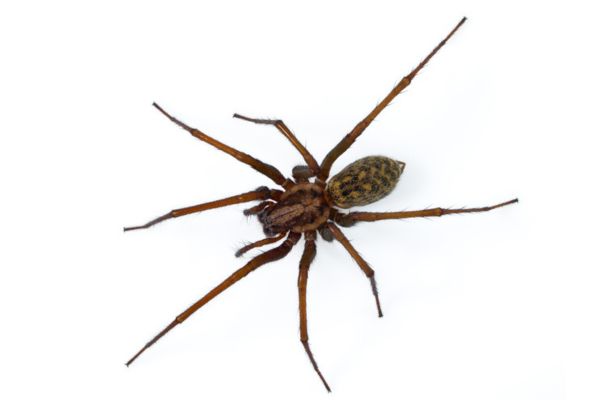
While some spiders can be identified at a glance by unique colors or shapes, the hobo spider is notoriously difficult to identify with the naked eye. In fact, the only way to accurately identify a hobo spider is to examine its reproductive organs under a microscope. However, being aware of their general physical traits can still be beneficial:
- Size: Hobo spiders are medium-sized, with body lengths ranging from about a half inch to one inch long. Their leg span can extend up to two inches.
- Color: They are usually light brown to yellowish-brown, but their coloration can vary, sometimes appearing darker or lighter depending on their habitat.
- Body and markings: Hobo spiders have a relatively robust and slightly flattened body. They often have a pattern of darker markings on their abdomen, which can be somewhat irregular or vaguely banded.
- Legs: Their legs are long, slender, and covered in fine hairs. They are usually a lighter brown with dark bands or stripes.
- Eyes: Hobo spiders have eight eyes arranged in two rows of four.
Brown recluse vs. hobo spider
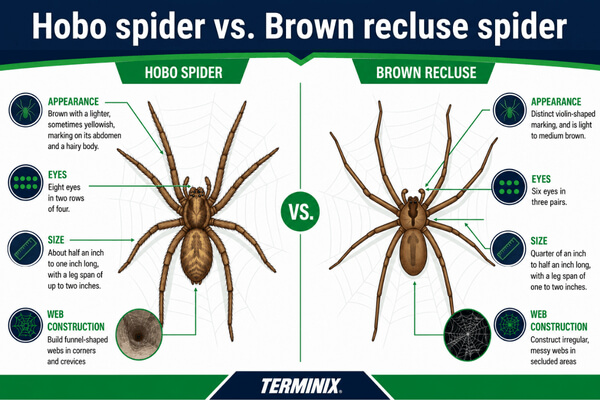
People frequently confuse the brown recluse spider and hobo spider due to their similar brownish coloring and size. However, these two species are never found in the same geographical areas. Brown recluse spiders are native to regions east of the Mississippi, while hobo spiders are exclusively found in the Pacific Northwest. Despite the lack of geographic overlap, understanding how to tell them apart is essential because a brown recluse bite is significantly more dangerous to humans.
- Appearance:
- The brown recluse has a distinct violin-shaped marking, is light to medium brown, and has six eyes in three pairs.
- The hobo spider is brown with a lighter, sometimes yellowish, marking on its abdomen, has eight eyes in two rows of four, and a hairy body.
- Size:
- The brown recluse is a quarter of an inch to half an inch long, with a leg span of one to two inches.
- The hobo spider is about half an inch to one inch long, with a leg span of up to two inches.
- Web construction:
- Brown recluses construct irregular, messy webs in secluded areas.
- Hobo spiders build funnel-shaped webs in corners and crevices.
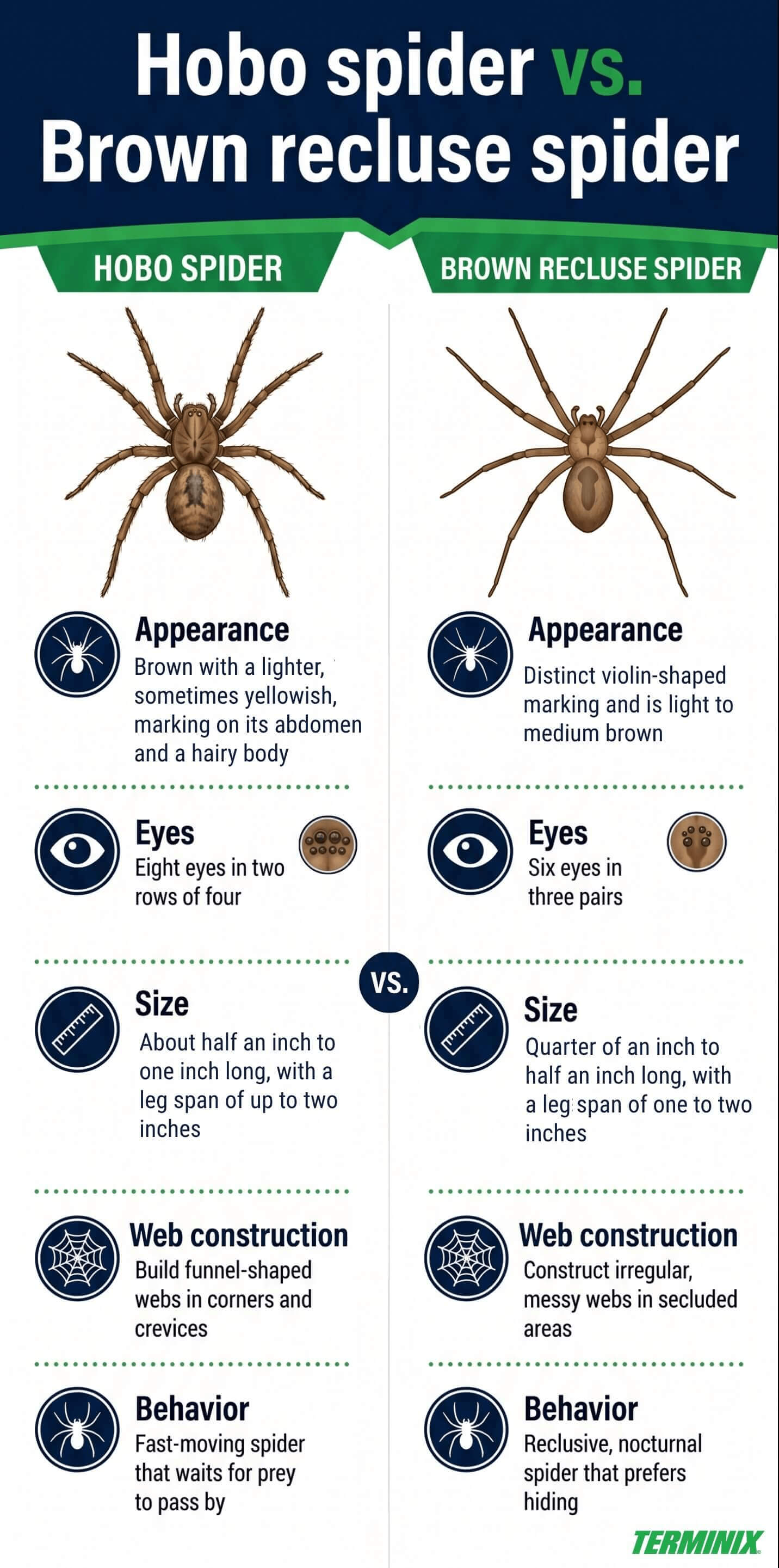
Hobo spider vs. Brown recluse spider: Know the difference
A side-by-side comparison of the appearance, eyes, size, and web construction of hobo spiders versus brown recluse spiders to help with identification.
Physical and Behavioral Comparison Table
| Feature | Hobo Spider | Brown Recluse |
|---|---|---|
| Appearance | Brown with a lighter, sometimes yellowish, marking on its abdomen and a hairy body. | Distinct violin-shaped marking, and is light to medium brown. |
| Eyes | Eight eyes in two rows of four. | Six eyes in three pairs. |
| Size | About half an inch to one inch long, with a leg span of up to two inches. | Quarter of an inch to half an inch long, with a leg span of one to two inches. |
| Web Construction | Build funnel-shaped webs in corners and crevices. | Construct irregular, messy webs in secluded areas. |
What do hobo spiders eat?
Hobo spiders primarily feed on insects and other small arthropods. Their diet includes common household and garden bugs such as ants, flies, cockroaches, silverfish, and beetles. Because they are sit-and-wait predators, their diet relies heavily on whatever crawling insects happen to wander onto their hunting platforms.
What do hobo spider webs look like?
Hobo spiders are skilled funnel weavers, creating distinctive funnel-shaped webs. A hobo spider web serves as both a home and a hunting ground. Their webs feature a tubular retreat where the spider hides during the day and a horizontal sheet that serves as a hunting platform. Hobo spiders use their webs to detect vibrations made by struggling prey, which they then ambush from their retreat. These webs are typically built in low-lying areas, corners, and crevices.
Are hobo spiders dangerous?
While hobo spiders are venomous, as are all spiders, they are not considered dangerous to humans. A hobo spider bite is relatively rare, as they are not aggressive unless trapped directly against human skin. If you do experience a hobo spider bite, the bite itself might cause minor localized redness, temporary pain, or mild swelling. The venom from a hobo spider bite can cause irritation, but it typically does not result in medical issues.
Where do hobo spiders live?
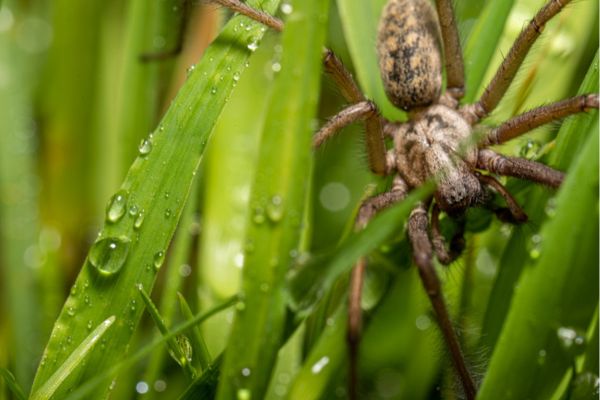
The hobo spider is found only in the Pacific Northwest in Washington, Idaho, and Oregon. Hobo spiders are particularly drawn to areas with minimal disturbance, such as holes and cracks, where they can construct their webs and hunt effectively. Their habitats include:
- Indoors: Dark, undisturbed areas such as basements, crawl spaces, and storage rooms.
- Outdoors: Wood piles, garden sheds, and under rocks or debris, as they favor cool, damp places where they can build their webs to trap prey.
How to get rid of hobo spiders in your home
Finding pests in your living space can be unsettling, especially if you start noticing frequent signs of spiders in the house. While a single spider can be ignored, multiple funnel webs in your basement could point to an underlying pest issue. Taking preventative steps and understanding how to keep spiders away can dramatically lower the chances of an indoor infestation.
If you find hobo spiders in your home, follow these steps:
- Avoid contact: Do not attempt to handle the spider.
- Seal entry points: Inspect your home for cracks, gaps, or other entry points and seal them to prevent more spiders from getting inside.
- Clean and declutter: Regularly clean and declutter your home, particularly in basements, attics, and storage areas where hobo spiders tend to hide.
- Contact Terminix: If you're unsure or concerned about a potential infestation, contact a professional to assess and address the situation.
While many spiders are completely harmless, finding them around your home makes many people uncomfortable. If diy spider pest control isn't giving you the results you want, Terminix is here to help.
Our professional solutions are designed to manage existing pests and establish long-term spider prevention. A skilled technician will thoroughly inspect your home's interior and exterior to locate and eliminate spiders, webs, and hidden egg sacs. We will treat active hiding spots, set up monitoring stations, and help you identify entry gaps to keep them out for good.
Don't let spiders take over your home. Schedule your inspection today!