Content updated: October 8, 2026

Key takeaways

  • Four common types of skunks inhabit North America: striped skunks, hooded skunks, American hog-nosed skunks, and spotted skunks.
  • All skunk species can spray oily musk up to 10 feet to defend themselves, which can cause temporary eye irritation and lingering odors.
  • While skunks consume garden pests, their foraging can damage property by digging holes 1 to 3 inches deep in lawns to find food.
  • Homeowners can deter skunks by securing food sources, clearing debris, sealing gaps in the foundation, or contacting Terminix for professional wildlife removal services.

Jump to section:

Skunk activity can get out of hand quickly. In their search for food, water, and shelter, skunks can become pests that can damage both your yard and home. Despite their reputation, the skunks that live among us can be beneficial animals. They quietly provide some homeowners with a natural form of pest control, eating many of the rodents and insects that we otherwise would not care to have as houseguests.

Learn about the types of skunks in your area and when it’s time for skunk control.

Types of skunks

There are 12 skunk species globally, usually categorized into broad groups, four of which you're most likely to encounter on your property.

A striped skunk standing on a paved sidewalk surrounded by fallen autumn leaves.

Striped skunks

Striped skunks (Mephitis mephitis) are the most common type of skunk found across the United States. They are frequently spotted in suburban neighborhoods, among other habitats. These skunks are black and usually about the size of a house cat. They feature prominent white stripes on their snout, along with a distinct white V-shaped marking on the back of their bodies. Striped skunks are the largest of any skunk species and can weigh up to 14 pounds.

A hooded skunk species with a thick white mane standing among autumn leaves in a forest.

Hooded skunks

Hooded skunks (Mephitis macroura) belong to the same genus as striped skunks and are primarily found in the southwestern region of North America and down into Central America. There are four subspecies of hooded skunks, but only the Northern Hooded Skunk is found in the U.S.

They are sometimes mistaken for striped skunks, but their tails are longer, and their fur is softer. Hooded skunks also sport distinctive tufts of long fur around their necks. Some have two thin white stripes running down their backs and tails, while others feature a single thick stripe with a solid white tail.

Close-up of a hog-nosed skunk species with a white-striped back foraging on small pebbles.

Hog-nosed skunks

While there are four main hog-nosed skunk species, the American hog-nosed skunk (Conepatus leuconotus) is the only one found in the U.S. In the U.S., they are restricted to a few southern and southwestern states, including Texas, New Mexico, Arizona, Colorado, and Oklahoma.

Hog-nosed skunks are large skunks (weighing 2 to 6 pounds) marked with a single broad white stripe that runs all the way from their nose to their tail. They inhabit rocky or sparsely timbered regions. Their long claws and hairless snout make them excellent diggers, and they frequently root through the soil for food.

A spotted skunk species with black-and-white patterned fur emerging from a tree trunk in snow.

Spotted skunks

There are seven different types of spotted skunks, including the eastern spotted skunk (Spilogale putorius), western spotted skunk (Spilogale gracilis), and southern spotted skunk (Spilogale angustifrons), the latter of which is also native to parts of North America.

These skunks have several broken white stripes along their backs and a black or white tip on their tail that is generally shorter than that of other skunks. Spotted skunks are notably small, weighing anywhere from 14 ounces to 2 pounds.

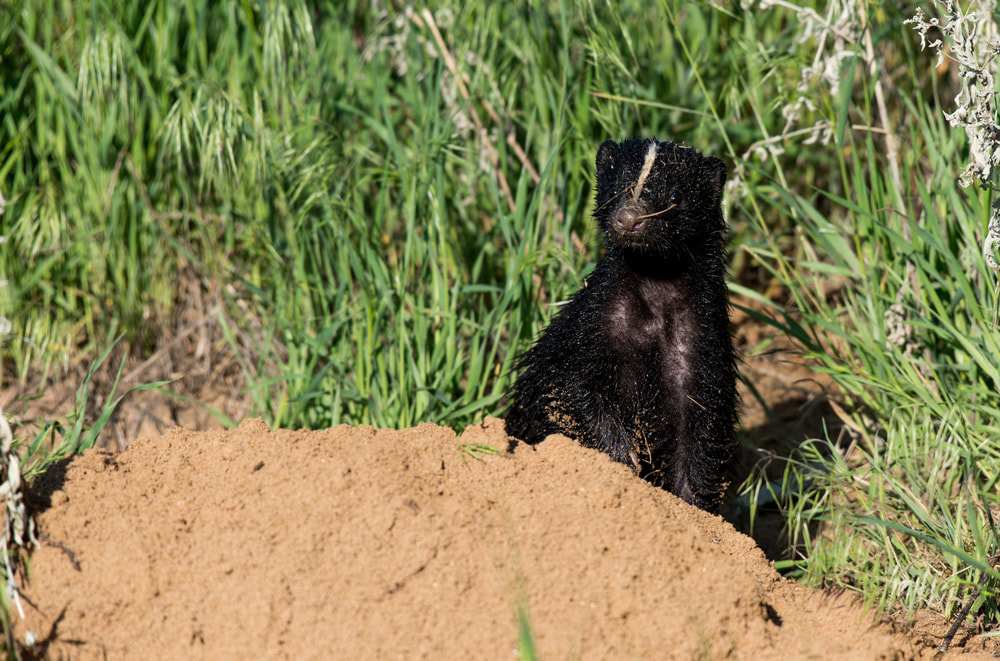
A stink badger walking on a leaf-covered forest floor among trees and small plants.

Stink badgers

When comparing a stink badger vs. a skunk, many people are surprised to learn that stink badgers are actually classified as a type of skunk. While they are not found in the United States, residing instead in the islands of Southeast Asia, they belong to the same family (Mephitidae) and share the trademark scent glands.