
What does a mouse nest look like?
Content Updated: August 11, 2026
Key takeaways:
A mouse nest is typically made from shredded materials such as paper, fabric, insulation, string, and plant material.
What a mouse nest looks like can vary, but nests are often rough, ball-shaped structures measuring about four to six inches in diameter.
A mouse nest can be home to about a dozen to two dozen mice, depending on their age and the presence of other mice nearby.
To find a mouse nest in your house, check behind kitchen appliances, inside cabinets, around baseboards, and in areas where you notice droppings or urine odors.
To help prevent mouse nests, store food in sealed containers, remove potential nesting materials, and seal cracks and gaps around your home.
Jump to section:
Finding a mouse nest in your home often means mice are living and breeding nearby. Knowing what a mouse nest looks like, where mice build their nests, and the signs of mouse activity can help you identify an infestation early. Learn how to find a mouse nest and what steps you can take to help prevent future nesting.
What does a mouse nest look like?
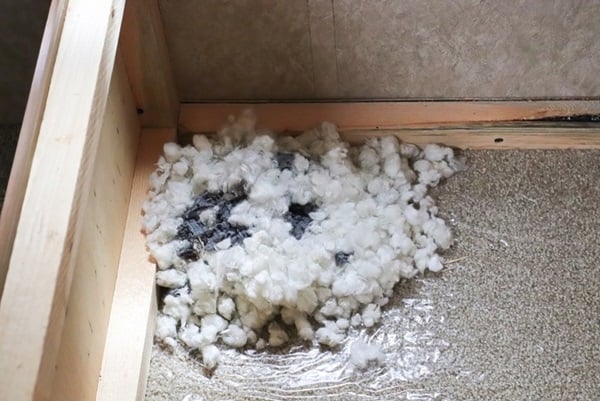
Mice construct their nests by harvesting materials that are plentiful and readily available. Mice are shy creatures, and they tend to confine their activities to a small radius. In fact, mice are rarely spotted more than 25 feet away from their nests.
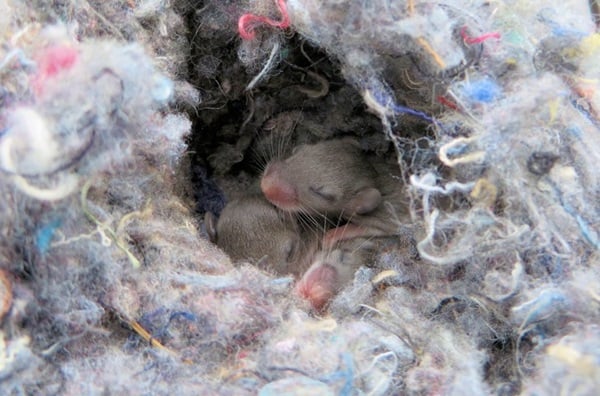
Paper, fabric, string, fiberglass insulation, mattress and pillow batting and plant material (e.g., straw) can all be easily shredded and transported by mice for the purpose of nest-building. House mice prefer to form their nests into rough, ball-like structures, about four to six inches in diameter.
A mouse nest may also look like loose piles of those same materials or like collections of wood chips, pellets and “fill” found in hamster cages and guinea pig enclosures. Mice are not clean animals, and they often leave droppings and scatter bits and pieces of scavenged food around their nests.
How many mice live in a nest?
Mice breed often, they breed rapidly and they do not stop breeding unless they are exterminated. Female mice carry their young for about three weeks, and each litter can be five to twelve pups. The average mouse nest can be home to between a dozen and two dozen mice, depending on their age and the presence of other mice in the vicinity.
Because mice nest in order to raise their pups, they seek out warm, dry areas that are well protected and close to a food source.
Where do mice like to make their nests?
Unfortunately, the average home’s kitchen features many mouse-friendly amenities. If you suspect you have a mouse problem, check behind kitchen appliances, including the refrigerator, freezer, dishwasher and oven. Areas around any gas-powered household appliance that features a pilot light, such as a hot water heater or range cooktop, may also be harboring mice.
Concerned homeowners should also check their pantry and all kitchen cabinets, especially seldom-used cabinets located close to the floor. Look for holes mice may have burrowed into your baseboards or drywall, loose nesting materials and droppings (elongated pellets, pointed at both ends, typically no more than one-quarter of an inch in length).
Also note any unusual musky, ammonia-like odors, as these may be indicative of urine trails mice use to demarcate their territories.
Prevent mice from making a nest in your house
The best way to keep mice from entering your home is to make sure it doesn’t offer an attractive and cozy place for them to build their nests.
Keep your kitchen clean and make sure all packaged foods are securely sealed. Consider transferring boxed and bagged pantry items such as breakfast cereals, flour, sugar, etc., to airtight plastic containers or steel canisters.
Don’t allow tempting mouse nesting materials to accumulate in your garage, basement or around the outside of your home. Dispose of empty cardboard boxes, make sure old clothes and linens are stored in rodent-proof containers and keep the landscaping around your home's foundation tidy.
Be sure to seal any cracks or gaps around your home’s foundation, in your walls and especially around electrical outlets and pipe fixtures in your kitchen.
Some homeowners suggest blocking cracks and open spaces around these common problem areas with a mixture of copper wool and caulk or foam sealant, as mice have difficulty chewing through these materials.