Japanese Honey Bee
(Apis Cerana Japonica)
Content Updated: June 26th, 2026
Key takeaways
- The Japanese honey bee is crucial for both ecological balance and agricultural productivity due to its adaptability and resilience.
- Japanese honey bees are similar in size to European honey bees, but their queens are larger, and they possess four distinct bands on their abdomens compared to the three seen in European honey bees.
- Bee balling is a defense mechanism used by Japanese honey bees, where they tightly cluster around a hornet intruder, generating heat and effectively suffocating or incapacitating the predator to protect their hive.
- Japanese honey bees are native to Japan and are not found in the United States.
Jump to section:
Japanese honey bee identification
The Japanese honey bee (Apis cerana japonica) is a fascinating and essential species that plays a vital role in the ecosystem and agriculture. Known for its adaptability and resilience, this bee has unique characteristics that set it apart from other honey bee species. Although you might not have to worry about enlisting the help of Terminix for bee control with this species, take a moment to learn everything you need to know about their behaviors, habitats, and more.
Japanese honey bee identification
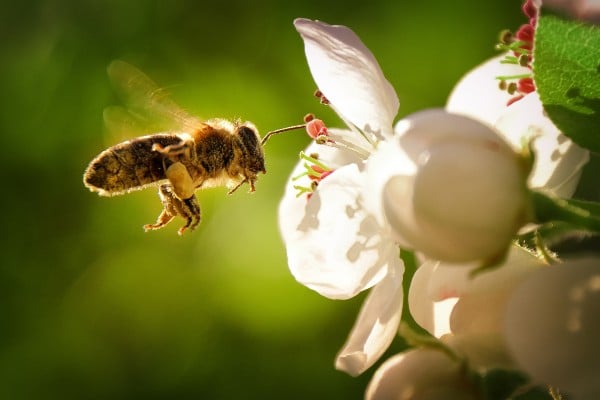
Japanese honey bees are comparable in size to the more commonly known European (or Western) honey bee, with queens being notably larger than the worker bees. Both species share distinct bands of gold and black on their abdomens, but Japanese honey bees display four more pronounced bands, in contrast to the three visible on their European counterparts.
Additionally, like all honey bee species, worker bees possess a specialized structure on their hind legs known as a "corbiculum," which serves as a pollen basket, along with their stingers. In general, queens are distinctly darker than the other bees in the colony.
Japanese honey bee behavior
Japanese honey bees are known for a unique behavior called “bee balling.” Hornets are aggressive and efficient killers capable of decimating honey bee colonies. To combat this predator, these bees from Japan have evolved a highly effective swarming behavior. When a hornet enters a Japanese honey bee hive, the worker bees surround it. They then vibrate their flight muscles, raising the temperature around the hornet to about 117 degrees Fahrenheit, a level lethal to the hornet but not harmful to the bees. However, if their colony is attacked by an Asian giant hornet, then they can’t defend against it.
Lifecycle and reproduction
Like European honey bees, Japanese bees undergo full metamorphosis with four life stages: egg, larva, pupa, and adult. Japanese honey bees live in colonies similar to, but smaller than, European honey bee colonies. Typically, a Japanese honey bee colony numbers around 34,000.
These bees from Japan will usually nest in cavernous areas, like hollow trees. Queens are reproductive females and lay a single egg in each brood cell. Worker bees are non-reproductive females, and they are responsible for several tasks within the colony, including guarding eggs, cleaning the hive, and producing honey. All male bees are drones, created to mate with the queen.
Similar to other honey bee species, the Japanese honey bee will swarm, sending a small offshoot of the colony to another location to establish a new colony. Japanese honey bees may swarm more frequently than other species.
Do Japanese honey bees sting?
Yes, Japanese honey bees do sting, just like other honey bee species. Curious about what they might sound like? You can learn more about what sound does a bee make to better understand hive activity. While their stings can be painful and may cause allergic reactions in some people, they are generally not aggressive unless their hive is disturbed.
Japanese honey bee habitats
Japanese honey bees are not found in the United States. They are a subspecies of the Asian honey bee (Apis cerana) and are native to Japan. They are more resistant to cold than European honey bees and can harvest pollen at temperatures below 50 degrees Fahrenheit.
Although they produce less honey than European honey bees, they are more efficient. They have a smaller range and a longer foraging period, allowing them to visit many of the same plants. Japanese bees are pollinators of several plants, including fruits, nuts, cauliflower, okra, and onions. They are kept for honey in the mountainous regions of Japan, where they have adapted to the terrain and climate.
Tips for control
Thankfully, homeowners in the United States won’t have to worry about how to get rid of bees for this specific species, as they’re not found in the country. Asian honey bees, including the Japanese honey bee, have fallen victim to deforestation and loss of nest sites within their native areas. Additionally, the introduction of the Western honey bee to Japan has contributed to a decline in the species’ numbers. Because of this, control is generally only recommended as a last resort.
However, in some parts of the world, including Australia, the Japanese honey bee may be considered an invasive species. Further research is required to determine whether, and to what extent, these bees will affect native populations in these areas. A primary concern is the introduction of pests carried by the Japanese honey bee that Australian honey bees have not been exposed to.
If you are dealing with other bee species closer to home and considering diy bee control, or if you want to find out how much bee pest control costs, it is always best to weigh your options carefully to protect local ecosystems.